Rising Ship Traffic Off South Africa Due To Middle East Conflict Increases Risk To Whales, Scientists Say
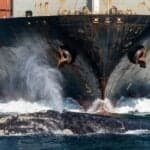


Scientists have warned that changing global shipping routes caused by conflicts in the Middle East are increasing the risk of whales being struck by vessels off South Africa’s south-western coast.
Researchers say the rerouting of commercial ships around the Cape of Good Hope since late 2023 has substantially raised the chances of collisions between vessels and whale populations that inhabit the waters around the Western Cape.
The increase in rerouted shipping began after Houthi rebels hijacked the British-owned vehicle carrier Galaxy Leader near Yemen in November 2023.
Ongoing attacks in the region and tensions involving the United States, Israel and Iran have since forced more shipping companies to avoid Middle Eastern waters.
According to figures from the International Monetary Fund’s PortWatch monitor, an average of 89 commercial vessels sailed around southern Africa between March 1 and April 24 this year, compared with 44 vessels during the same period in 2023.
The findings were presented to the International Whaling Commission by Professor Els Vermeulen and her team from the University of Pretoria’s Whale Unit.
Vermeulen said the researchers studied where different whale species are commonly found around the Western Cape and compared those areas with current shipping routes to identify where collisions are most likely to happen.
The study found a significant overlap between important whale habitats and increasingly busy shipping lanes off South Africa’s coast.
Continued attacks in the Red Sea region and tensions involving Iran have since led more operators to reroute ships around southern Africa instead of using Middle Eastern routes.
Vermeulen said the increase in high-speed vessel traffic was especially concerning.
“The fastest traffic, which poses the greatest strike risk, has increased by a factor of four,” she told AFP.
She also said collisions are difficult to measure because many happen far offshore. In many cases, dead whales sink to the seabed instead of washing ashore, making the actual number of strikes hard to estimate. Researchers refer to this as “cryptic mortality”.
Environmental scientists and activists have also raised concerns after videos posted on social media showed cargo ships travelling through large groups of humpback whales near South Africa’s coast.
Vermeulen said some people posting the videos focused on the number of whales they could see, but she feared several animals may have been struck by vessels moving through the area.
She said whales may not realise ships are a danger, especially while feeding.
Chris Johnson, global lead of WWF’s Whale and Dolphin Conservation initiative, said some whale species do not move away from vessels even when they hear approaching ships.
He gave the example of blue whales off Los Angeles, which often move slightly below the surface instead of leaving the area completely.
Researchers also said changing whale behaviour may be adding to the problem.
Ken Findlay, a blue economy consultant who contributed to the report, said large “superpods” of humpback whales have been feeding seasonally off South Africa’s west coast since 2011.
He said the growing number of whales in busy shipping areas could increase the chances of collisions.
A 2024 paper published in the journal Science described ship strikes as a major cause of whale deaths worldwide.
Researchers also noted that there are still limited protection measures in place for whale species recovering since the 1986 international whaling ban.
The report presented to the International Whaling Commission said small changes to shipping lanes could reduce the risk for some whale species by between 20% and 50%.
According to the researchers, moving traffic lanes slightly further offshore would add only about 20 nautical miles to journeys that can exceed 10,000 nautical miles.
Vermeulen also suggested reducing vessel speeds during certain times of the year, although she said more data is needed before firm recommendations can be made.
Her team plans to carry out offshore whale population surveys by aircraft and boat, but she said they would need more support for the work.
“It’s been nice to see how much people want to come together to solve this. So now the onus is on the scientific community to come up with reliable data on the offshore whale population,” she told the BBC.
Estelle van der Merwe, head of the Ocean Action Network NGO, said one possible solution could involve warning ships about whale superpods through radio messages or mobile applications.
There is also research into using AI-enabled cameras on vessels to help detect whales at sea.
South Africa’s Department of Forestry, Fisheries and the Environment said all available measures would be examined once scientific studies and assessments are completed.
The department said maritime authorities would work with environmental officials to decide the next steps.
Why Ships Are Diverting
The Cape of Good Hope has become a critical alternative shipping route for vessels avoiding the Red Sea and Suez Canal due to security risks in the Middle East.
Commercial ships travelling between Asia and Europe normally use the Suez Canal because it offers the shortest route.
However, attacks on merchant vessels near Yemen and instability around the Strait of Hormuz have forced many operators to reroute around southern Africa.
The Strait of Hormuz is one of the world’s most important maritime chokepoints for global energy and cargo trade.
Any disruption in the region can quickly affect international shipping patterns.
Researchers said the increase in high-speed commercial traffic around South Africa is raising the risk of ship strikes, particularly for humpback and blue whales feeding near busy sea lanes.
References: BBC, phys
Want to read more?
Check out the full article on the original site