Brazilian Navy, Federal Police Seize 340 Kg Cocaine Hidden On Greek Bulker At Port Of Santos
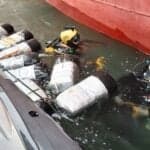


Brazilian Federal Police have seized around 340 kilograms of cocaine from a bulk carrier at the Port of Santos during a joint inspection operation involving the Brazilian Navy, Federal Revenue Service, and Santos Port Authority.
The drugs were found on Sunday, May 10, inside a submerged compartment in the hull of the vessel while it was docked at the port and preparing to sail to Europe.
Police divers, along with divers from the Brazilian Navy, searched the vessel underwater and recovered several bundles of cocaine hidden in the ship’s sea chest.
Local reports said the operation recovered around 341 kg of the illicit substance.
The vessel involved was identified as the Liberia-flagged Green K-Max 1, an 80,900-dwt bulk carrier built in 2019 and managed by Greece-based Aegean Eco Carriers.
Per reports, the ship had arrived from India and was loading cargo before departing for Poland.
According to the Federal Police, the operation was carried out after intelligence work and risk monitoring at the Port of Santos.
Crew members aboard the vessel reportedly spotted a suspicious small craft near the ship while it was at anchor and informed authorities.
After the drugs were removed from the vessel, the seized material was taken to the Federal Police headquarters in Santos for forensic examination.
Authorities also opened an investigation to identify those responsible for the attempted international drug trafficking operation.
Maritime intelligence company Vanguard Tech reported that crew members had noticed the suspicious boat operating near the vessel before the discovery of the cocaine.
Brazilian authorities described the operation as complex because the drugs had been hidden in a submerged section of the ship that required divers to access.
Officials said sea chests are commonly used by smuggling groups to hide drugs on commercial vessels.
The Port of Santos is considered one of the main routes used for cocaine smuggling operations linked to Europe-bound shipments.
Authorities said monitoring efforts at the port have been increased as part of ongoing efforts to stop trafficking networks.
Spain, Italy, Portugal, the United Kingdom, and the United States continue operations targeting what they described as the “Atlantic Cocaine Highway.”
Officials said traffickers have been changing routes and using smaller ports in an attempt to avoid detection.
During operations carried out in April, European authorities intercepted eight vessels, arrested 54 people, and seized 11 tonnes of cocaine along with 8.5 tonnes of hashish.
Officials involved in those operations said traffickers are using containerships, bulk carriers, and smaller non-commercial vessels to move drugs between South America and Europe.
Spanish authorities also recently intercepted a small cargo vessel in the Mediterranean carrying an estimated 30 to 45 tonnes of drugs, with investigators suspecting that smaller boats would have distributed the cargo across multiple European locations.
Technical Breakdown
A sea chest is a recessed compartment built into the hull of a ship below the waterline. It is primarily used to collect seawater for onboard cooling and machinery systems.
Because the compartment remains submerged and is difficult to access without divers, criminal groups have increasingly used sea chests to conceal narcotics on commercial vessels.
The Green K-Max 1 is a kamsarmax bulk carrier, a vessel type designed to carry dry bulk cargoes while meeting size restrictions for ports such as Kamsar in Guinea.
The vessel has a deadweight tonnage of approximately 80,900 dwt and measures around 229 metres in length.
References: Brazilian Federal Police
Want to read more?
Check out the full article on the original site