US Navy Drone Boat Rescues Two Pilots Off Oman in First-Ever Sea Recovery
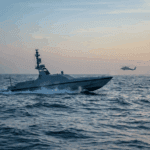


A U.S. Navy drone boat pulled two downed Army aviators from the water off Oman this week, in what military officials are calling the first real-world rescue of aircrew by an unmanned surface vessel.
The two crew members had been flying an AH-64 Apache attack helicopter that went down near the Strait of Hormuz late on Monday, June 8. A Saronic Corsair autonomous surface vessel found the pair in the water and recovered them within roughly two hours, according to U.S. Central Command (CENTCOM). Both were reported in stable condition. CENTCOM said the cause of the crash remains under investigation.
The vessel belongs to the U.S. 5th Fleet’s Task Force 59, the Navy’s unit for autonomous systems and artificial intelligence into Middle East operations. “The surface drone that assisted in last night’s rescue of the Apache crew off the coast of Oman was a U.S. Navy Corsair unmanned surface vessel,” CENTCOM spokesman said. The task force began fielding the drones in the region in late March, he added.
The Corsair picked up the two soldiers and carried them to another position at sea, where they were hoisted aboard a helicopter for onward transport to medical care. U.S. Naval Forces Central Command, the 82nd Airborne Division, and U.S. Air Force and Navy units all had a hand in the wider operation, CENTCOM said.
What sets the episode apart is the asset that did the work. Sea drones have run surveillance, reconnaissance, and live-fire trials for years. None had been publicly credited with plucking people from the water until now.
The Corsair is built by Saronic Technologies, a defense firm based in Texas. The 24-foot craft resembles a speedboat and is designed for long-endurance work far from shore. Its maker lists a top speed above 35 knots, a range beyond 1,000 nautical miles, and a payload capacity of 1,000 pounds, or about 454 kg. The design was first shown in 2024.
Iran did not immediately claim the shoot-down. The semi-official Mehr News Agency reported that no claim of responsibility had been made, and Iranian state media cited a military source who denied any offensive air operations in the strait over the previous 24 hours.
On Tuesday, CENTCOM said its forces began “self-defense strikes” against Iran at the president’s direction, calling the action a proportional response to what it termed unjustified Iranian aggression. Iran then launched retaliatory attacks on U.S. bases in Bahrain, Kuwait, and Jordan, according to multiple reports.
The strait sits at the center of the standoff. Roughly a fifth of the world’s seaborne oil normally moves through the narrow channel, which Iran has kept under pressure since the wider conflict began in March.
Want to read more?
Check out the full article on the original site