World’s First Oceangoing Ammonia Dual-Fuel Vessel Delivered
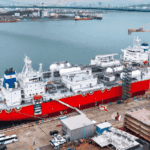


A Belgian gas carrier has become the first oceangoing ship to run on an ammonia-fueled engine, a notable step in shipping’s slow shift toward zero-carbon fuels.
The vessel, a midsize gas carrier named Antwerpen, was delivered to owner EXMAR on June 10 after a development program that ran more than three years. EXMAR, an Antwerp-based gas shipping and infrastructure group, called the handover a historic moment for low-carbon shipping.
Antwerpen was built by HD Hyundai Heavy Industries in South Korea. It is the product of a multi-partner effort that brought together engine designer WinGD, engine builder HD Hyundai Engine Machinery Division, fuel-system supplier Nord Gas Solutions — formerly Wärtsilä Gas Solutions — and classification society Lloyd’s Register.
The ship can carry up to 46,000 cubic metres of ammonia or LPG, and it can burn the same ammonia it transports as fuel. That dual-fuel capability is the breakthrough. Running on low-carbon ammonia, EXMAR says, the vessel emits close to zero greenhouse gases, cutting emissions by as much as 90 percent against a conventional ship.
At its heart is a WinGD X-DF-A two-stroke engine. The unit injects ammonia at high pressure and adds only a small pilot dose of conventional fuel — about five percent at full load — to ensure clean combustion. Shaft generators and a selective catalytic reduction system, which strips nitrogen oxides from the exhaust, complete the propulsion package.
Ammonia appeals as a marine fuel because it carries no carbon. It is also toxic, which put safety at the centre of the design. The vessel is fitted with real-time gas detectors to catch leaks and an ammonia purge recovery unit, among other detection and mitigation systems. EXMAR leaned on four decades of experience hauling ammonia as cargo, working with the Belgian maritime administration and Lloyd’s Register to build the rules and safety case for using it in the engine room.
Antwerpen measures 190 metres in length and 27,000 deadweight tonnes. EXMAR had the design stretched by 10 metres, with a slightly wider beam, to fit more cargo than a standard carrier of its class.
The ship is the first of four ammonia dual-fuel gas carriers EXMAR has ordered from HD Hyundai, each named after a Belgian city. Antwerpen and its sister Arlon were named at the Ulsan yard in April. Two more are due later this year, with the fourth following in early 2027.
The delivery arrives as regulators and owners weigh ammonia’s place in a decarbonising fleet. The International Maritime Organization approved interim guidelines for using ammonia cargo as fuel on gas carriers in May, clearing a key hurdle. HD Hyundai pointed to International Energy Agency forecasts that ammonia could supply 8 percent of marine fuel demand by 2030 and nearly half by 2050.
For EXMAR, the handover turns a long-running engineering project into a working ship. “Ammonia propulsion is no longer theoretical—we are deploying it,” said Carl-Antoine Saverys, the group’s chief executive. The real test now begins at sea, where Antwerpen’s performance will help shape the vessels — and the regulations — that come next.
Want to read more?
Check out the full article on the original site