Indonesia Begins Construction Of Two 2,000-Ton Advanced Scorpène Submarines Under $2.1 Billion Deal
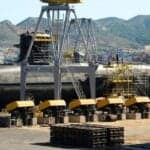


Indonesia has started building two Scorpène Evolved submarines in partnership with French defence company Naval Group, marking the country’s first domestic construction of the advanced conventional submarines.
The submarines are being built by state-owned shipbuilder PT PAL under a technology transfer agreement with Naval Group.
The programme is intended to strengthen Indonesia’s submarine fleet while helping the country develop its own submarine-building capabilities.
The contract, worth between $2.1 billion and $2.16 billion, was signed in March 2024 and came into force on July 23, 2025. It is also the first export order for the lithium-ion battery version of the Scorpène submarine.
Indonesia sees the project as part of its long-term plan to become self-reliant in submarine construction. The country aims to develop the capability to design, build and eventually export its own submarines between 2042 and 2050.
The Scorpène Evolved is designed to carry out missions against both surface ships and submarines, while also supporting intelligence-gathering operations. It features a new propulsion system, full lithium-ion batteries and Naval Group’s SUBTICS combat management system.
With its lithium-ion battery configuration, the submarine is designed to stay on missions for up to 80 days. It can carry up to 18 heavyweight torpedoes and SM39 Exocet anti-ship missiles.
Naval Group has also confirmed that it will be able to launch the next-generation SM40 submarine-launched Exocet missile, which is currently being developed by MBDA.
The submarine is also equipped with a Platform Management System (PMS), which controls and monitors key onboard systems, including propulsion, energy generation, diving safety and auxiliary equipment.
The system collects information from programmable logic controllers located throughout the vessel and manages the submarine’s operations.
According to Naval Group, the Indonesian submarines will be built using the same specialised steel used in French attack submarines. The material requires strict welding standards and multiple quality inspections.
To prepare for construction, 20 PT PAL employees completed two to three months of training in Cherbourg, France, where they learned welding techniques, preheating procedures and quality control.
Naval Group said it is providing ongoing technical support and training under the programme. The company currently has eight experts working with PT PAL, with the team expected to grow to around 50.
French and Indonesian personnel have also been paired to support knowledge transfer, while French staff are learning Bahasa Indonesia to improve communication.
Indonesia’s order makes it the first country to export the lithium-ion battery version of the Scorpène submarine. It also joins Brazil, Chile, India and Malaysia as operators of the Scorpène class.
Unlike traditional offset agreements, the partnership includes the transfer of submarine design methods, pressure hull construction, systems integration, production management and long-term maintenance expertise to Indonesia.
PT PAL previously gained experience through the construction of Type 209 submarines. The Scorpène programme expands that experience by introducing advanced manufacturing techniques, including stealth technologies, combat system integration and lithium-ion battery management.
Preparations for construction included infrastructure upgrades, workforce training and improvements to production systems. PT PAL completed its steel-cutting qualification in December 2025, meeting the standards required for pressure hull construction.
The Scorpène Evolved also features acoustic-reduction technologies developed from French submarine programmes to reduce noise during operations. Its sonar system uses advanced signal processing to improve the detection and tracking of submarines, surface ships and unmanned underwater vehicles.
Compared with conventional diesel-electric submarines that use lead-acid batteries, the lithium-ion battery system allows the submarine to spend more time underwater while reducing the need to surface for battery charging.
The submarine has an operational range of more than 8,000 nautical miles and can reach speeds of over 20 knots while submerged.
Indonesia’s location along key shipping routes, including the Malacca, Sunda and Lombok straits, makes submarine capability an important part of its maritime strategy.
The submarines are expected to support surveillance, intelligence gathering and sea-denial operations across Indonesia’s waters.
PT PAL and Naval Group have also discussed making Indonesia a regional production, maintenance and repair hub for future Scorpène operators.
The second submarine is expected to enter construction in 2027. Sea trials for the first submarine are planned between 2030 and 2032, with delivery expected in 2032.
The second submarine is expected to undergo sea trials between 2031 and 2033 before being delivered in 2033. Officials said the schedule could be accelerated if the programme progresses as planned.
The project is expected to create around 2,250 skilled jobs across manufacturing, engineering, systems integration and long-term submarine support. It also involves several Indonesian companies alongside PT PAL as part of efforts to expand the country’s defence industry.
References: interestingengineering, defencesecurityasia
Want to read more?
Check out the full article on the original site