China Equips Its Newest Aircraft Carrier With World’s First Operational Hard-Kill Anti-Torpedo Defence System
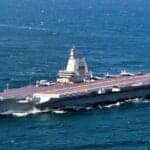


China has reportedly equipped its newest aircraft carrier, Fujian, with what Chinese defence publications describe as the world’s first operational hard-kill anti-torpedo defence system on an aircraft carrier.
The system is designed to intercept and destroy incoming torpedoes before they hit the ship.
Most aircraft carriers currently rely on soft-kill countermeasures such as acoustic decoys and jammers, which try to confuse or divert incoming torpedoes instead of destroying them.
The South China Morning Post, citing Chinese defence publication Defence Review, reported on July 3 that the Type 003 Fujian is fitted with six-tube 324 mm launchers believed to be part of an Anti-Torpedo Torpedo (ATT) system.
China has not officially confirmed that the system is operational, and no independently verified test results have been released.
However, Chinese military analysts believe the launchers visible on the carrier are intended for the anti-torpedo system.
The Fujian entered service on November 5, 2025, becoming China’s first domestically built supercarrier and its first aircraft carrier equipped with an electromagnetic aircraft launch system (EMALS).
The carrier is about 316 metres long, 76 metres wide, and displaces more than 80,000 tonnes at full load, making it China’s largest warship and the largest aircraft carrier outside the U.S. Navy.
Unlike China’s earlier carriers, Liaoning and Shandong, which use ski-jump launch systems, the Fujian uses electromagnetic catapults that allow aircraft to take off with heavier fuel loads, weapons and other payloads.
The carrier is expected to operate aircraft including the J-15T fighter, J-35 stealth fighter and KJ-600 airborne early warning aircraft.
From Soft-Kill to Hard-Kill Defence
According to the reports, the Fujian replaces the 12-tube depth-charge launchers used on Liaoning and Shandong with rotating six-tube 324 mm launchers installed beneath the flight deck on both sides of the ship.
Rather than attacking submarines, the reported ATT system is designed to stop an incoming heavyweight torpedo during the final stage of its attack after it has passed the carrier group’s outer anti-submarine defences.
This is different from traditional soft-kill systems such as acoustic decoys, jammers, bubble screens and towed countermeasures, which try to divert or confuse a torpedo instead of destroying it.
Chinese researchers said the new system has achieved “world-class” detection accuracy, interception reliability and system integration. They said it builds on an earlier Chinese anti-torpedo technology demonstrator that was first revealed in 2016.
According to Chinese reports, the interceptor uses a rocket booster for initial acceleration before switching to pump-jet propulsion powered by a permanent-magnet synchronous direct-drive motor.
It is said to reach speeds of 50 to 60 knots within about three seconds after launch while maintaining a relatively low acoustic signature.
The reports also said the interceptor uses broadband sonar to identify real torpedo threats and distinguish them from decoys. It is also designed to communicate with the carrier through a two-way underwater acoustic data link after launch.
If multiple interceptors are fired, they could reportedly coordinate with each other to engage different targets.
Chinese publications said the interceptor is designed to damage or destroy an incoming torpedo by targeting its propulsion system, guidance section or warhead before it reaches the carrier.
Some reports also mentioned possible supercavitation speeds of up to 200 knots during very close-range engagements, although they noted there is no independently verified evidence supporting that claim.
Heavyweight Torpedoes
Heavyweight torpedoes remain one of the biggest threats to aircraft carriers because they strike below the waterline and can damage propulsion systems, steering gear, machinery spaces and the hull.
Water also transfers shock more effectively than air, increasing the risk of structural damage.
Modern torpedoes can use wire guidance, acoustic homing or wake-homing systems, allowing them to continue tracking a target even after encountering some countermeasures.
Chinese defence analysts said this makes hard-kill defence systems especially important because the U.S. Navy operates a large fleet of nuclear-powered attack submarines armed with Mk 48 heavyweight torpedoes, which are its main anti-ship weapon.
They also noted that U.S. surface warships do not have anti-ship cruise missiles comparable to China’s YJ-18 or anti-ship ballistic missiles similar to the YJ-21.
Similar Programmes Abroad
The United States previously developed the Anti-Torpedo Torpedo Defense System (ATTDS), but the programme was later cancelled after facing reliability and performance issues during testing.
The U.S. Navy is now developing the Mk 58 Countermeasure Anti-Torpedo Compact Rapid Attack Weapon (CRAW) together with improved AN/SLQ-25E Nixie soft-kill systems, with broader deployment expected around 2030.
Europe is also working on anti-torpedo interceptor programmes, including SeaSpider and PESCO Anti-Torpedo Torpedo, while Russia has deployed Paket anti-torpedo systems on some surface warships, though not on aircraft carriers.
Despite the Chinese reports, Western analysts say active anti-torpedo interception remains one of the most difficult areas of naval warfare.
Unlike missile defence, underwater interception is made more difficult by acoustic distortion, thermal layers, limited sensor visibility and very short reaction times. Aircraft carriers also produce significant underwater noise, which can affect sonar performance.
No independently verified data has confirmed the Fujian’s reported interception capability, sonar performance or effectiveness against advanced heavyweight torpedoes such as the U.S. Mk 48.
Some defence observers have also questioned whether the launcher seen on the Fujian is dedicated only to anti-torpedo defence or whether it could also perform other anti-submarine warfare roles.
The Fujian is based at Sanya Naval Base on Hainan Island, about 350 kilometres from the disputed Paracel Islands.
References: armyrecognition, militarywatchmagazine
Want to read more?
Check out the full article on the original site