Something’s Brewing on the Big Island
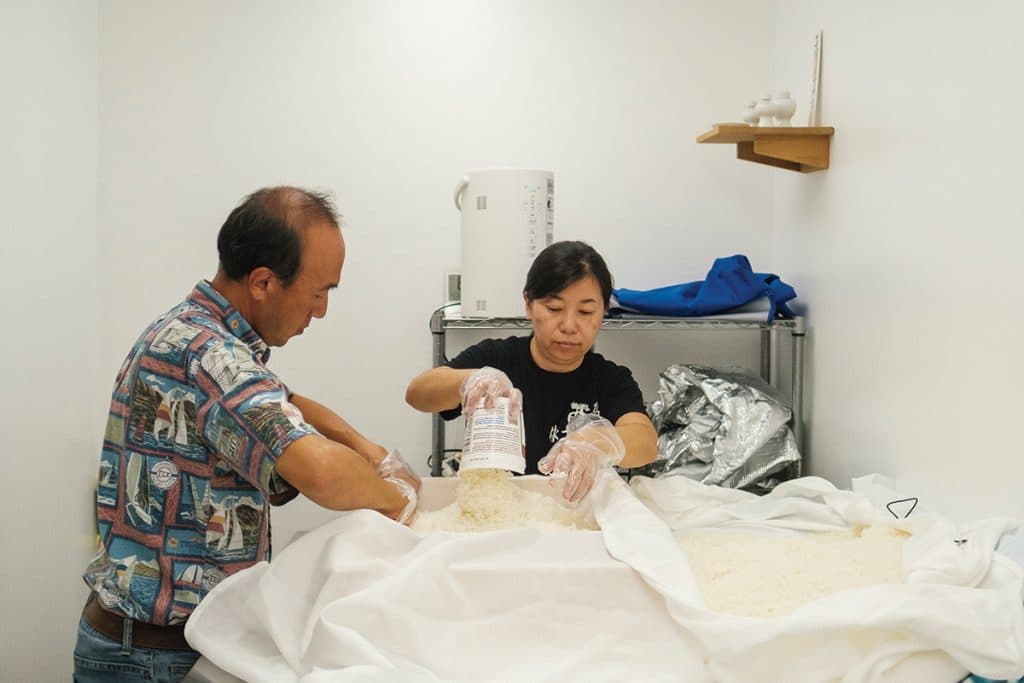
At the base of Maunkea on the sunny leeward side of Hawai‘i Island, a small-batch brewery is handcrafting high-quality sake using Japanese rice, centuries-old techniques, and Hawai‘i’s natural elements.
Islander Sake Brewery’s location is deliberate. Here, cool, dry winds mean more moderate temperatures, which is key during the early stages of sake fermentation. Hawai‘i also offers an abundance of soft, low-mineral water that’s ideal for sake making.
To get to the brewery and tasting room, visitors drive along a paved road through manicured fairways and greens of Hāpuna Golf Course.
I pull up to an unassuming tan building and ascend a double staircase, following signs to a modern Japanese-inspired entryway. Here, warm earth tones are accented by subtle cultural nods like noren curtains and bamboo.
Stepping through the curtains, I find museum-quality displays that include a collection of ornate sake sets and utilitarian brewing tools. Nearby, a retail section showcases chilled sake bottles, mini gift sets, and specialty sake glasses—the same vessels used in the tasting I’m here to experience.
The tasting room, which also serves as the dining room for the restaurant Engawa, is empty at first, but quickly fills with chatter and laughter from my group of six.
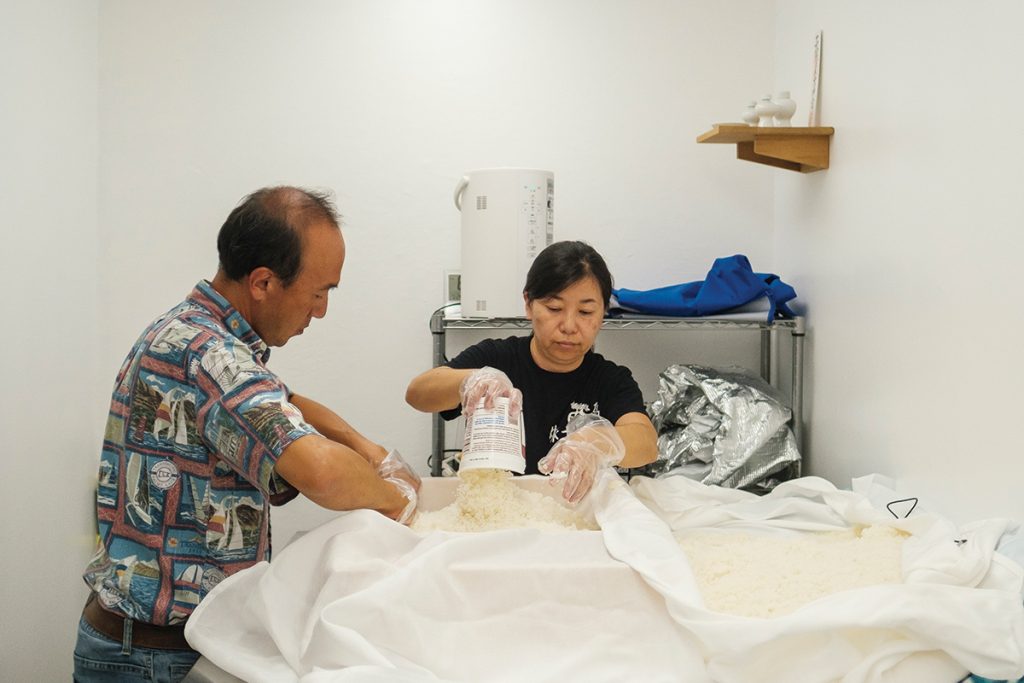
Photo: Aaron K. Yoshino
We’re greeted by co-founder Tama Hirose, who focuses on front-of-house operations and expertly guides us through a tasting of five housemade sakes. Rather than cleansing the palate with water between pours, as one might during a wine tasting, he encourages us to let each new flavor build on the one before it.
I’m impressed by the wide range of sake styles, including flavored sakes like liliko‘i (passion fruit), Kona coffee, and yuzu; refined, elegant junmai daiginjo; creamy, unfiltered nigori; as well as a 4-year-aged sake. The brewery also releases limited-edition bottles, including one that celebrates 2026, the Year of the Horse; it’s naturally sweet, with a crisp apple aroma.
Out of the full collection, a tropical fruit-infused junmai daiginjo, bursting with flavor from juicy local pineapple, quickly becomes my favorite. As we taste, Hirose explains everything from ingredient sourcing to the reasoning behind different sake glass shapes and how sake’s storied history in Hawai‘i continues to guide the brewery’s approach today.
After all, Hawai‘i was home to one of the first—and certainly most influential—sake breweries outside of Japan: Honolulu Sake Brewery, which opened on O‘ahu in 1908. It went on to change the global industry through innovations in fermentation efficiency and refrigeration technology, making year-round production possible in warmer climates. At its peak, Hawai‘i had up to 10 sake breweries. But after World War II, Honolulu Sake was the only one standing; it closed in 1989.
Nearly 30 years later, in 2018, Islander Sake Brewery opened; its owners were determined to revive the art of Japanese sake brewing in Hawai‘i. As the only licensed sake brewery in the state, and one of roughly 30 in the U.S., its opening once again positioned the Islands at the forefront of an evolving industry.
Historically, sake brewing in Japan was a profession exclusively for men; women weren’t even allowed to step inside a brewery, let alone become a tōji (brewmaster). Today, Dr. Chiaki Takahashi serves as Islander Sake Brewery’s president, sake brewmaster—one of just 35 women in the world to hold the distinguished title—and restaurant chef.

Photo: Aaron K. Yoshino
For 20 years, Takahashi worked as a medical researcher in a demanding role. One evening, while sipping sake as part of her nightly ritual, she had an epiphany. If drinking sake was her way to relieve stress, she recalls thinking, then perhaps she should change her career from medical researcher to sake maker. A decade later, she followed another long-held dream by moving to Hawai‘i, where Islander Sake Brewery was born.
Takahashi takes a strong hands-on approach to her business. “I make food and also make sake—I think the only one in the world [doing] the sake making and then food making and then serving the customer,” she says.
In addition to guided tastings and brewery tours, guests can experience Islander Sake Brewery at dinner at Engawa, named after the Japanese equivalent of a lānai (patio), a transitional space traditionally used for casual conversation and light snacks.
I returned for that dinner a couple of months after my lively sake tasting, only this time with a smaller group, which feels more aligned with the restaurant’s intimate, upscale atmosphere.
The dining room is intentionally small, with just six tables accommodating up to 20 guests across two nightly seatings—a choice that reflects Takahashi and Hirose’s shared enjoyment of engaging directly with diners.
Dinner showcases kaiseki, a style of Japanese dining that began as a light meal served during tea ceremonies before evolving into a formal multicourse culinary celebration. For Takahashi, it’s personal: She learned to cook from her mother, who prepared meals at the Buddhist temple where Takahashi spent her childhood.
“The food is all my mother’s recipes,” Takahashi says of Engawa’s menu. “If I cook the food, I remember my mother.”
Each dish on the monthly multicourse tasting menu presents nostalgic, homestyle flavors with artful elegance. Avoiding repetition, the curated experience emphasizes seasonality, balance, and the connection between food and sake.
My prix fixe offerings include a trio of light appetizers, chilled tofu with seasonal vegetables, assorted sashimi, grilled fish and vegetable tempura, plus oshizushi (pressed sushi). The meal includes a glass of junmai daiginjo, with optional add-ons like a premium sashimi course and guided sake pairings.
For dessert, an artisanal ice cream made using the brewery’s own sake kasu (paste leftover from fermentation commonly used in cooking) provides a fitting close, highlighting the brewing process until the very last bite.
Islander Sake Brewery, Hāpuna Golf Course, 62-100 Kauna‘oa Drive, Waimea, (808) 517-8188, islandersake.com.
This story was originally published in our SPRING/SUMMER 2026 issue, which you can buy here. Better yet, subscribe and get HAWAIʻI Magazine delivered right to your mailbox.
Ashley Probst is a contributor to HAWAIʻI Magazine.
Want to read more?
Check out the full article on the original site