India Races Towards A 200-Ship Fleet By 2035 To Counter China And Pakistan
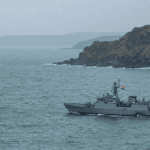


The Indian Navy is driving towards a fleet of more than 200 ships by 2035, and New Delhi has presented two commissionings within a fortnight as evidence that the target is now within reach. The force currently operates around 150 ships and submarines, of which roughly 135 are counted as frontline combatants such as frigates, destroyers and submarines, with close to 50 further hulls under construction in Indian yards.
INS Malvan, the second Mahe-class Anti-Submarine Warfare Shallow Water Craft (ASW-SWC), was commissioned at Karwar in Karnataka on 22 July. Built by Cochin Shipyard Limited with more than 80 per cent indigenous content, the 78-metre craft displaces about 1,100 tonnes and runs three diesel engines driving waterjets for a maximum speed of 25 knots. The Ministry of Defence has described the vessel as equipped for underwater surveillance, anti-submarine warfare, low-intensity maritime operations, and mine laying, with sensors from DRDO and Bharat Electronics Limited, and lightweight torpedoes supplied through DRDO and Bharat Dynamics Limited.
Malvan is the sixth of 16 ASW-SWCs to enter service and the second of the eight boats allotted to Cochin Shipyard under a Rs 13,000 crore programme split with Garden Reach Shipbuilders and Engineers, work on which began in 2019.
Eleven days earlier at Visakhapatnam, India’s Defence Minister commissioned INS Mahendragiri, the sixth Nilgiri-class stealth frigate built under Project 17A, designed in-house by the Navy’s Warship Design Bureau and constructed by Mazagon Dock Shipbuilders Limited with more than 75 per cent indigenous content. A seventh and final ship of the class, Vindhyagiri, is reported to be months away from delivery, with a further batch of next-generation frigates under Project 17B already queued behind it.
The Chief of the Naval Staff, has put the current tempo at one indigenously built warship or submarine entering service roughly every 40 days, following 12 warships and one submarine commissioned during 2025. Behind the ships already afloat sits a pipeline the Defence Acquisition Council has cleared through Acceptance of Necessity for 74 further warships worth Rs 2.35 lakh crore, comprising 65 surface vessels and nine submarines, alongside the long-delayed Project 75(I) programme for six air-independent propulsion submarines.
The urgency behind those numbers is being read in the Indian Ocean rather than in the shipyards. The Pentagon’s annual assessment of Chinese military power puts the People’s Liberation Army Navy battle force at more than 370 ships and submarines, the largest fleet in the world by hull count, and Beijing has steadily widened its footprint across the Indian Ocean Region through port access, survey vessels and submarine deployments. Pakistan commissioned the first of eight Chinese-built Hangor-class attack submarines, PNS/M Hangor, at Sanya in China on 30 April, with four of the class being assembled at Wuchang Shipbuilding and four more at Karachi Shipyard and Engineering Works under a technology transfer arrangement.
Shallow-water hunters such as Malvan are the Indian Navy’s answer to the coastal end of that problem, screening approaches to ports, anchorages and offshore infrastructure where deep-water frigates lose their advantage and conventional submarines can sit quietly on the bottom.
India’s own conventional submarine arm remains the weakest link in the 2035 arithmetic, with only six Scorpène vessels delivered against an earlier plan for 24 new conventional submarines by 2030. INS Tamal, handed over from Russia in July 2025, was the last foreign-origin warship the Navy intends to take, and every hull counted towards the 200-ship goal is now expected to be built in an Indian yard.
Reference: ANI/PIB
Want to read more?
Check out the full article on the original site