Iran Says Ukrainian Strike Killed Sailor On Its Ship In Caspian Sea
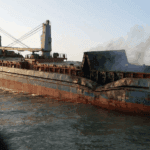


Iran’s Ministry of Foreign Affairs has accused Ukraine of striking an Iranian commercial vessel in the Caspian Sea, saying an explosion aboard the ship killed one sailor and injured a second crew member.
Tehran summoned Ukraine’s diplomat the same day to protest against what the ministry described as a hostile and criminal act, and it framed the strike as a violation of the United Nations Charter and as an act of aggression capable of widening the Russia-Ukraine war, according to state news agency IRNA. The ministry also restated Iran’s long-held position that it has never intervened in the conflict between Moscow and Kyiv, and it warned that Iran would act to protect its national security and interests.
Ukrainian President Volodymyr Zelenskyy said in a social media post that Ukrainian forces had achieved strong results from long-range strikes in Caspian waters against vessels moving military cargo in cooperation with Iran, along with a warship, though he did not identify the merchant ship Tehran says was hit.
The Security Service of Ukraine (SBU) set out a fuller target list on its Telegram channel, stating that long-range drones operated overnight on 25 July against the Filanovsky field oil platform operated by Russian producer Lukoil, the cargo ship Port Olya 2, the dry cargo ship Begey, and a Project 12418 Molniya-class missile boat.
The agency said both merchant vessels sit under international sanctions and had been used to carry military cargo between Iran and Russia, and it presented the operation as a lawful response to Russian strikes on Ukraine’s southern ports that have sought to choke Ukrainian shipping.
Ukraine’s military intelligence directorate lists Begey as a Russian-flagged general cargo ship, sanctioned by the United Kingdom and by Canada, and records 11 calls by the vessel at the Iranian ports of Amirabad, Nowshahr, Astara and Anzali, along with a pattern of AIS transmission gaps near port approaches. The same intelligence body attributes Port Olya 2 to sanctioned Russian operator MG-Flot, formerly known as Transmorflot.
Those registry details sit awkwardly against Tehran’s account, because both ships named by Kyiv are recorded as Russian-flagged and Russian-owned, while Iran describes the casualty vessel as an Iranian merchant ship with an Iranian crew. Neither government has released the name, flag or IMO number of the vessel aboard which the reported death occurred, and no flag-state casualty notification has surfaced.
The Caspian route linking Iran’s northern ports to Astrakhan has drawn repeated Ukrainian attention, most visibly in August 2025 when the dry cargo ship Port Olya 4 was destroyed at the Russian port of Olya while reportedly loaded with Shahed-136 drone components and Iranian munitions, halting logistics operations at the Caspian hub for roughly a week. That corridor also carries substantial legitimate trade under the International North-South Transport Corridor, which means operators calling at Amirabad, Anzali, Astrakhan and Makhachkala now face a war-risk profile that did not exist on this landlocked sea two years ago.
Iranian Foreign Minister raised the incident in a call with European Union High Representative and pressed for a firm response from both the EU and the UN Security Council, IRNA reported. Russia has made no public comment on the reported strikes, and the extent of damage to any of the vessels involved remains unclear.
Reference: Al Jazeera/Times of Israel
Want to read more?
Check out the full article on the original site